Cute Tea Cart Clipart Design: A Practical Evaluation
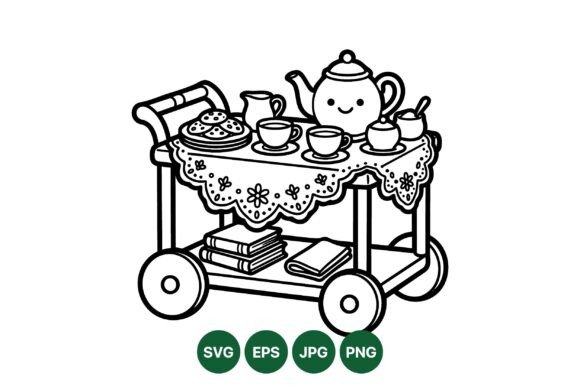
The Cute Tea Cart Clipart Design is a specific digital asset characterized by black and white vector line art. This illustration depicts a rolling tea cart adorned with a smiling teapot, cups, cookies, and books situated beneath a decorative lace tablecloth. The aesthetic is intentionally cozy and charming, utilizing high-contrast lines to create a distinct visual identity. For designers, crafters, and content creators, understanding the technical specifications and stylistic limitations of this artwork is essential before integrating it into a project.
Defining the Visual Style and Technical Specifications
At its core, this design relies on the principles of monochromatic line art. Unlike raster images that use pixels to define color gradients and shading, this clipart uses mathematical paths to define shapes. The description highlights a "high-contrast" approach, meaning the lines are bold enough to remain visible even at small sizes or when printed on textured paper. The inclusion of elements like a smiling teapot and books suggests a narrative quality, evoking themes of hospitality, reading, and comfort.
Technically, the product is delivered as a ZIP folder containing multiple file formats: SVG (Scalable Vector Graphics), PNG (Portable Network Graphics), JPG (Joint Photographic Experts Group), and EPS (Encapsulated PostScript). The presence of SVG and EPS files confirms that the artwork is 100% vector-based. This distinction is critical for users who require scalability. Vectors allow the image to be resized infinitely without losing resolution, whereas raster formats like JPG and PNG are resolution-dependent and may appear pixelated if enlarged beyond their native dimensions.
Reasons for Interest in This Specific Asset
Several factors drive interest in the Cute Tea Cart Clipart Design. First, the thematic elements align with popular niches such as vintage home decor, baby shower invitations, and lifestyle branding. The combination of tea, books, and lace appeals to audiences seeking a nostalgic or "shabby chic" aesthetic. Second, the black and white format offers versatility. Because the image lacks pre-defined colors, it can be easily recolored within vector editing software to match specific brand palettes or project requirements.
Furthermore, the availability of multiple file formats addresses diverse workflow needs. Graphic designers working in professional suites like Adobe Illustrator or CorelDRAW will prioritize the EPS and SVG files for their editability. Conversely, hobbyists using simpler tools or preparing files for instant printing may find the included PNG and JPG versions more convenient. The promise of "sharp results at any size" directly addresses a common pain point in digital design: the need for an image that looks crisp on both a business card and a large banner.
Benefits and Tradeoffs
The primary benefit of this clipart is its scalability. Since the artwork is vector-based, users can scale the tea cart up to billboard size or down to a stamp size without any degradation in quality. This makes it an efficient choice for projects requiring multi-format usage. Additionally, the high-contrast line art ensures excellent legibility. When used for die-cutting machines, such as Cricut or Silhouette, thick, clean lines translate well to physical cuts, reducing the risk of machine errors caused by faint or broken lines.
However, there are tradeoffs to consider. The most significant limitation is the lack of inherent color. While this allows for customization, it also means the user must invest time in coloring the image if they do not wish to leave it in black and white. This requires access to vector editing software and a degree of technical proficiency. Furthermore, the "cozy and charming" style is subjective. The whimsical nature of a smiling teapot may not fit every context, particularly those requiring a strictly modern, minimalist, or corporate aesthetic.
Another consideration is the complexity of the details. The decorative lace tablecloth and the arrangement of cookies and books involve intricate linework. While these details add charm, they can become muddy if the image is scaled too small for certain print applications, such as tiny labels or fine-textile prints. Users must evaluate the intended output size against the density of the line work.
Ideal Situations for Use
The Cute Tea Cart Clipart Design is a strong fit for several specific scenarios. It is particularly effective for print-on-demand products where the design is applied to items like mugs, tote bags, or t-shirts using heat transfer methods. The high contrast ensures the design transfers cleanly. It is also well-suited for scrapbooking and card making, where the black and white lines can be colored by hand with markers or watercolors, adding a personal touch.
In digital contexts, this clipart works well for blog headers, social media graphics, and website banners related to lifestyle, food, or book clubs. The vector nature ensures fast loading times compared to heavy raster images while maintaining clarity on high-resolution displays. Additionally, the design is appropriate for educational materials, such as children's activity sheets or coloring books, where the clear outlines facilitate easy coloring by young users.
When Alternatives May Be Worth Considering
Despite its strengths, this specific clipart may not be the optimal choice for all projects. If a project requires photorealism, this line art is unsuitable. Similarly, if the design brief demands a complex color palette with gradients, shadows, and lighting effects, a flat vector illustration will require extensive manual work to achieve the desired depth, potentially making a pre-colored raster image or a custom illustration a better investment.
Users with very limited technical skills might also find the vector files challenging to utilize fully. If a user cannot open SVG or EPS files, they are restricted to the provided PNG and JPG versions, which limits their ability to resize the image significantly. In such cases, a simple, high-resolution JPEG from a stock photo site might be more practical. Finally, if the project targets a demographic that prefers sleek, modern aesthetics over whimsical, vintage styles, the "smiling teapot" motif could clash with the overall brand identity.
Practical Decision-Making Insights
Before selecting the Cute Tea Cart Clipart Design, readers should assess their technical capabilities and project goals. Ask whether you have the necessary software to edit vector files. If you only need a static image for a single-use web graphic, the included PNG might suffice. However, if you anticipate needing to resize the image or alter its colors, the SVG and EPS files are indispensable.
Consider the end medium. For laser cutting or vinyl weeding, the high-contrast lines are advantageous. For full-color magazine advertising, you may need to verify if the level of detail in the lace and cookies will reproduce well in CMYK print. Finally, evaluate the emotional tone. Does the "cozy and charming" vibe align with your message? If the goal is to evoke warmth and nostalgia, this design is a strong candidate. If the goal is efficiency and neutrality, a simpler geometric icon might serve better.
Ultimately, the value of this clipart lies in its balance of artistic style and technical flexibility. By understanding its strengths as a scalable vector asset and its limitations regarding color and stylistic specificity, users can make informed decisions about whether it aligns with their creative needs.